Scoliosis
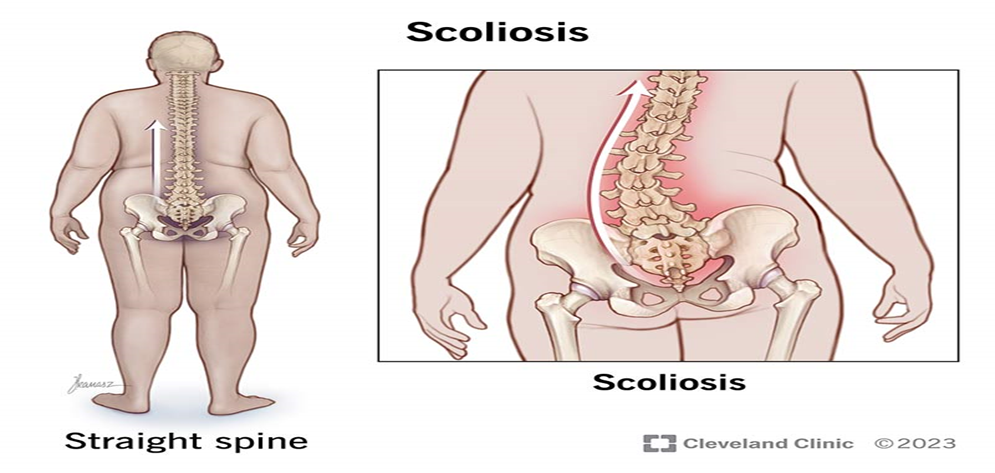
Scoliosis is an abnormal, sideways curvature of the spine that forms an "S" or "C" shape. A normal spine is straight when viewed from the front or back, but in scoliosis, the spine curves and twists. Scoliosis most often develops during the growth spurt just before puberty, typically between ages 10 and 18.
Common Symptoms
Most cases of scoliosis are mild and do not cause pain in the early stages, but visible signs include:
- Uneven shoulders (one shoulder blade higher than the other).
- One shoulder blade that is more prominent than the other.
- Uneven waist or hips.
- A noticeable lean to one side when bending forward.
- Clothing hanging unevenly.
- In severe cases, difficulty breathing due to pressure on the lungs.
Causes and Types
The cause of about 80% of scoliosis cases is unknown (called "idiopathic scoliosis"). Other types include:
- Congenital Scoliosis: Caused by malformed vertebrae present at birth.
- Neuromuscular Scoliosis: Develops as a result of conditions affecting muscles and nerves, such as cerebral palsy or muscular dystrophy.
- Degenerative Scoliosis: Occurs in adults due to age-related changes, arthritis, or osteoporosis.
- Syndromic Scoliosis: Occurs as part of an underlying syndrome.
Treatment Options
Treatment depends on the severity of the curve (the angle), its location, and the patient's age:
- Observation: Mild curves (less than 20 degrees) are usually just monitored regularly to check for progression.
- Physical Therapy: Helps improve posture, flexibility, and strength.
- Bracing: May be used for adolescents who are still growing to prevent the worsening of moderate curves (typically between 25 and 45 degrees).
- Surgery: For severe curves over 45-50 degrees, surgery may be necessary to correct the curvature and stabilize the spine.
Back strengthening exercises play a significant role in supporting the spine, alleviating pain, and improving posture for patients with scoliosis. The goal is to strengthen the core muscles on both sides of the curve as evenly as possible to achieve balance.
1. Side Plank
This is highly effective for strengthening the lateral torso muscles that support spinal alignment.
- How to Perform: Lie on your side with your elbow directly under your shoulder. Lift your hips off the floor so your body forms a straight line from head to feet. Hold this position for as long as possible, then repeat on the other side.
2. Superman Exercise
Helps strengthen the lower and upper back muscles.
- How to Perform: Lie on your stomach with arms extended forward and legs back. Lift your arms, legs, and chest off the floor simultaneously using your back and glute muscles. Hold for 3-5 seconds, then lower slowly. Repeat 10 times.
3. Bridge Exercise
Strengthens the glutes, lower back, and hamstrings, providing a strong support base for the spine.
- How to Perform: Lie on your back with knees bent and feet flat on the floor. Slowly lift your pelvis upward, hold for a few seconds, then lower slowly. Repeat 10 times.
4. Resistance Band Rows
Targets the muscles between the shoulder blades, which are often weak in scoliosis patients.
- How to Perform: Sit or stand holding a resistance band. Pull the band towards your waist, squeezing your shoulder blades together. Return slowly and repeat 10-15 times.
