Genu valgum (knock knees):
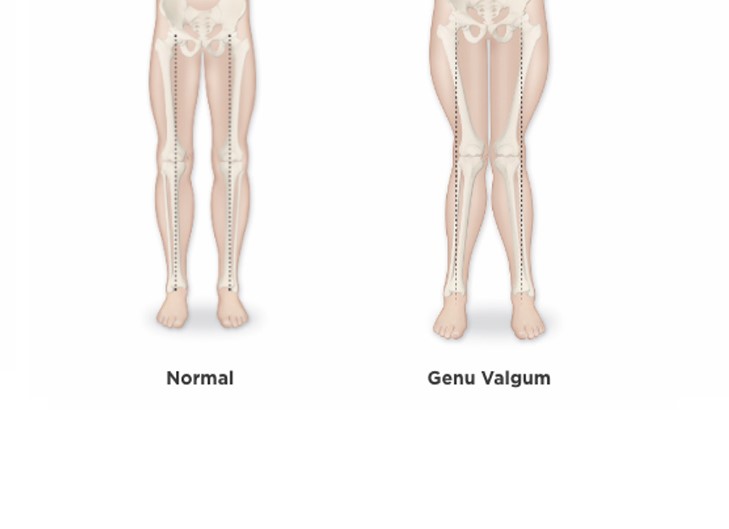
Genu valgum, or knock-knees, is a condition where the knees angle inward and touch, causing the ankles to be farther apart when the legs are straightened. It is common in young children and often corrects itself with growth. In some cases, it can persist or develop in older children and adults due to other conditions.
Causes
The causes of genu valgum vary depending on age.
In children, causes may include:
- Normal growth: It is a normal part of a child's development, peaking between ages 3 and 5, and usually resolves by age 7 or 8.
- Rickets: This bone growth problem is caused by a lack of vitamin D or calcium.
- Injury: A fracture or other injury to the bones around the knee's growth area can cause misalignment.
- Obesity: Excess weight can place abnormal pressure on the knees.
- Genetic conditions: Some skeletal dysplasias or congenital (inborn) conditions can affect bone development.
In adults, causes can include:
- Long-term effects: Knock-knees from childhood that did not correct themselves can lead to joint problems over time.
- Arthritis: Severe arthritis, particularly in the knee, can alter joint alignment.
- Injury: Trauma or a malunited fracture (improperly healed break) can cause the condition.
Symptoms
Symptoms are often visible and may cause other issues.
- Visible leg deformity: Knees touching or nearly touching when standing, while ankles are spaced apart.
- Gait abnormalities: An altered walking pattern, sometimes described as a waddle or limp.
- Pain: Discomfort can affect the knees, hips, or ankles due to uneven weight distribution.
- Stiff joints: The condition may cause stiffness or a reduced range of motion in the knees and hips.
- Instability: A feeling of the knee giving way, particularly in more severe cases.
Diagnosis
A doctor will perform a physical examination and may order imaging tests to determine the cause and severity. This can involve:
- Reviewing medical history: Including any family history of similar conditions.
- Observing the patient: The doctor will watch the patient stand and walk to assess their legs.
- X-rays: Used to evaluate the bones and joint angles, especially for severe cases or if an underlying condition is suspected.
Treatment
Most childhood cases resolve naturally, but treatment may be needed for severe or persistent cases.
- Observation: For most children, observation is the only treatment needed as the condition improves with growth.
- Correcting underlying issues: If the condition is caused by a nutritional deficiency like rickets, supplements and other medical treatments may be recommended.
- Physiotherapy: Can help improve muscle strength and alignment, especially in adults.
- Bracing: In some cases, a brace or cast may be used to help align the bones, though they are less commonly used for children than in the past.
- Surgery: In rare, severe cases that don't improve with conservative treatment, surgery may be recommended. For children, a guided growth surgery can help correct the deformity. For adults, an osteotomy (bone reshaping) may be performed.
When to see a doctor
You should see a doctor if:
- The knock-knees appear before age 2 or persist after age 7.
- The condition is getting worse over time.
- Only one leg is affected or the leg lengths are different.
- There is persistent knee, hip, or ankle pain.
- The child has a limp or trouble walking.
- The child's height is significantly below average.
